
by Trần Trung Tín
Entering the Unknown
As one of the ‘Boat People’ escaping communism in Vietnam, I spent a year in a refugee camp on Galang Island, Indonesia, before departing for resettlement in November 1982. Back then, I intended to hit the ground running as soon as I got to the U.S. But when I boarded the plane, the pilot was speaking over the intercom about all sorts of things in English. I strained to listen, but the only phrase I could catch was: ‘Fasten your seat belts.’ Right then, I got a sinking feeling. I realized that if I couldn’t even understand a standard flight announcement before we had even taken off, my goal to start working had officially ‘gone off the rails!‘
Once I arrived in the U.S., I had to completely change my approach. I needed to find a way to go to school, and fast—I was already pushing 30 back then, you know? On top of that, everything in the U.S. was in English, and my English was “just stellar!” There were only two English as a Second Language (ESL) classes available, and my placement test landed me right in the bottom one.
Writing essays in ESL classes was my ultimate nightmare! I was a pro at chatting effortlessly in Vietnamese. But when it came to writing, I racked my brain and tore my hair out just trying to find the words. As for English writing? Totally clueless.
Back then, my ESL teacher was a tough-as-nails professor with a Ph.D. in English. He was way past retirement age but kept at it just for the pure love of teaching. The man was an absolute master, but a relentless nitpicker when it came to making sure your writing said exactly what you meant.
Throughout the semester, I could not even remember how many times I had to rewrite assignments he sent back. Honestly, I also completely lost track of the hours I clocked at the English tutoring office begging for help.
Nowhere was his perfectionism more apparent than when he asked us to write about a well-known short story from our own culture. We had to submit an outline and receive approval before we could begin writing.
Vietnamese literature boasts fantastic short stories. When I first resettled in the U.S., I was super excited to share these tales—like Giấc mộng kê vàng (‘A Golden Millet Dream’) or Từ Thức về trần (‘Tu Thuc Returning to the Mortal World’)—with Americans. The latter is especially fascinating because, much like Washington Irving’s Rip Van Winkle, it revolves around the classic theme of time displacement.
However, the more I thought about those two stories, the more intimidated I became. Honestly, I probably would have needed to be reincarnated as a native English speaker and gotten some liquid courage to have the guts to write stuff like that in English.
Since my English was poor and my writing skills were weak, I had to look for a truly simple story to write. Even if I wrote it terribly, I figured the professor would still grasp the basic meaning. That was my only hope for surviving the class.
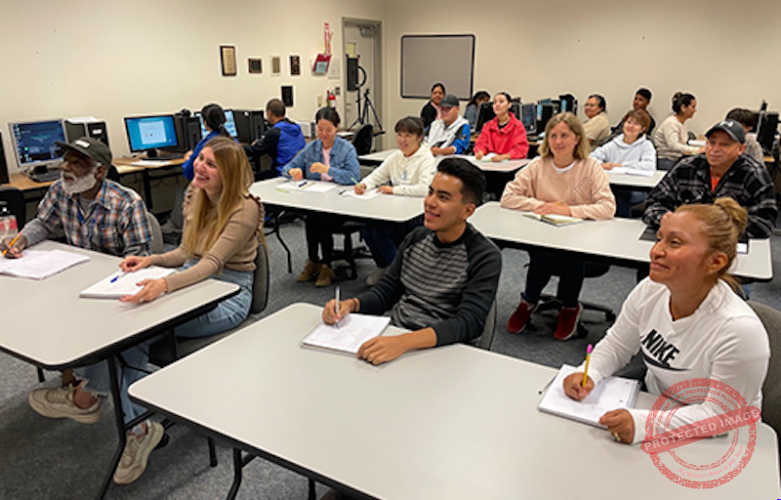
Back in 1983 without Google, I had to rely on memory for Vietnamese tales. I chose Tái Ông Thất Mã—a timeless proverb originally from China. However, it’s been ‘Vietnamized’ for ages, so I figured using it wouldn’t hurt.
To keep the title from sounding Chinese, I just made up a brand new one off the top of my head: The Old Man, his Son, and the Mare.
As for the outline of the short story—it’s straightforward as can be:
- Once upon a time, on the edge of the woods, lived an old man, his son, and their mare. One day, a fierce storm suddenly blew their shed away, spooking the mare and causing her to run deep into the forest.
- The neighbors felt bad for him, saying it was total bad luck. The old man just shrugged: “Not necessarily a bad thing.”
- A few days later, the mare—unaccustomed to the wilderness—somehow found her way back home. Amazingly, she even lured a wild stallion back with her.
- The neighbors congratulated the old man on his good luck, but he just brushed it off: “Not necessarily a good thing.”
- Soon after, the son took the wild stallion out for training. The fiercely aggressive and untamed horse threw the boy off and broke his leg.
- The neighbors came by to offer their pity, but the old man just said, “Not necessarily a bad thing.”
- Before conquering a neighboring kingdom, the King enacted a military draft for all young men. Because of a broken leg, the old man’s son was exempted.
- By then, the neighbors were too worried about their own children’s fates to visit the old man and celebrate his son’s good fortune.
I handed in my outline feeling very confident it was perfectly organized. But less than five minutes later, the professor called me up to hand it back. Right next to the phrases ‘Not necessarily a bad thing’ and ‘Not necessarily a good thing,’ he had scribbled two massive red question marks with the word ‘Why?’
His feedback totally burst my bubble. I mean, come on, things just happened the way they happened. Looking at those two parts, why on earth would I even question why that stubborn old dude didn’t see it as a good or bad thing? I was at a complete loss as to how to break that down.
I took my outline back to the professor to ask exactly why it was rejected, and he explained that the premise is nonsense. Specifically, he noted that calling something ‘not necessarily a bad (or good) thing’ requires contextual justification. Without that, the whole outline didn’t make sense.
Man! I hadn’t even been in the U.S. for a full year—barely long enough to get used to the local tap water—and here I was wondering how in the world to explain to an American professor, a walking encyclopedia of English, why Vietnamese stories seemed determined to leave the important parts unsaid!
I dragged my outline to my seat, feeling absolutely gutted. It looked like I had totally ‘gone off the rails’ again! At this rate, it seemed as though I had already lost before the results were even out.
As a low-income student back then, keeping my financial aid was a balancing act. I had to take at least 12 units to remain full-time and maintain a ‘C’ average or better—on a scale where ‘A’ is the highest mark and ‘F’ is failing. Falling below that meant losing my aid the following year—and appealing the decision would have been a waste of time.
At that point, I had been grinding on those essays day and night, wasting so much damn time. I was stuck, falling behind on my other classes, and heading straight for a complete collapse—from extreme hardship to straight-up disaster!
Realizing I had no time remaining and no alternative but to take a desperate measure, I decided to go for broke. I acted as though the professor was on board with my outline and simply wrote the short story.
For the story breakdown, I stuck exactly to the outline. But to keep the professor from tossing my paper out again like last time because it ‘makes no sense,’ I had to sweat a bit more this time and cram in some extra commentary and conclusion, as follows:
“Essentially, from a Vietnamese perspective, the moral of the story was that today’s bad luck could be the seed for tomorrow’s good luck—and tomorrow’s good luck might just be the setup for the day after’s bad luck. And the cycle repeats itself.
“In other words: nobody can predict the future. Therefore, we just do what must be done today and let the future take care of itself.”
Although it sounded rhetorically unorthodox, I wanted to make sure it resonated with the professor.
Come the day the paper was due, and it hit me that the professor never actually greenlit my outline. When I walked up to his desk, I hid behind a few other students to be safe. If he happened to remember my face, he’d probably toss my paper out, and I’d get an ‘F’. Basically, I was back to square one: all that writing felt completely wasted!
A week later, to my absolute shock, I opened my returned paper to find a perfect score and two handwritten words: Wise story! Needless to say, I was thrilled—far happier than the Old Man’s son finding out he’d dodged the draft! Back then, even if you paid me big bucks, I wouldn’t have been stupid enough to ask the professor why he’d thrown out my outline in the first place.
I just had to bite the bullet and ride it out, but my curious nature kept nagging at me about why my outline and essay had completely ‘gone off the rails.’
Different Tracks, Same Destination
About 10 years later, by the early 1990s, I relocated to Japan for work. One day at the office, my colleagues—all Japanese—were whispering among themselves, then came over to my desk and invited me to check out a small temple in the Tokyo suburbs that weekend. It looked like they were trying to pull off some big surprise on me.
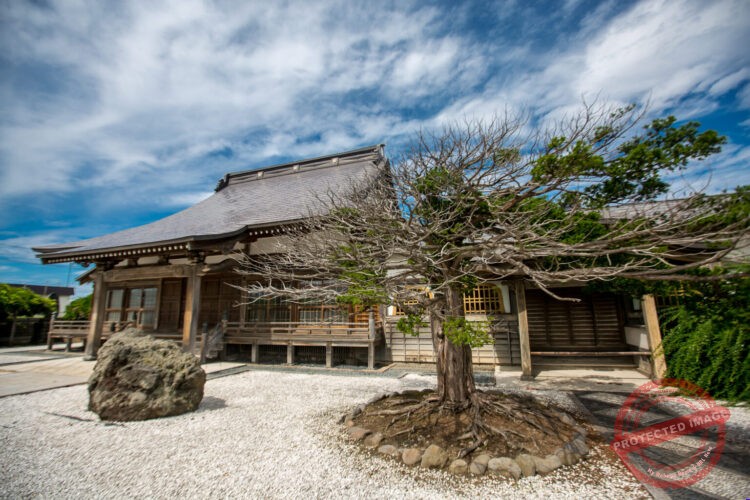
Sure enough, when we got there, the head monk was Vietnamese! He had come to Japan as an international student in 1965. After finishing college, he stayed in Japan and got a job. Roughly a decade thereafter, he shaved his head and entered the monkhood. His master later handed the temple over to him.
Just hearing him speak, I immediately recognized his Northern dialect—a voice echoing the historic wave of roughly one million refugees who fled communism from North to South Vietnam during the 1954 exodus. Yet, despite the grand, dramatic entrance his accent gave him, the monk broke the ice by introducing himself as Monk Tâm, which literally means “Heart.” He casually told me to call him “Anh Tâm” (using “Anh” for older brother) to keep things friendly.
The Japanese locals were incredibly considerate. They excused themselves to tour some nearby spots, giving the two of us from the Vietnamese diaspora a chance to take a trip down memory lane in our mother tongue.
We caught up for a bit before the conversation fizzled out. Suddenly, a recollection from my school days popped into my head. I asked Anh Tâm about the time my outline had totally ‘gone off the rails’ compared to my essay on The Old Man, his Son, and the Mare.
Upon hearing the story, Anh Tâm paused to ponder for a moment before speaking softly and gently:
“Many Western academic traditions prioritize strict logic and clear, explicit explanations. Because of this, people trained in these environments lean heavily on rational reasoning. They tend to look at intuition with a skeptical eye, viewing it as something easily swayed by changing emotions. When they run into something unexplainable, they’re quick to dismiss it as pure “nonsense.” It’s like doing a math problem: one bad calculation is all it takes to ruin the whole equation. The same goes for a story—if a core event doesn’t add up, the entire plot feels like it makes no sense.
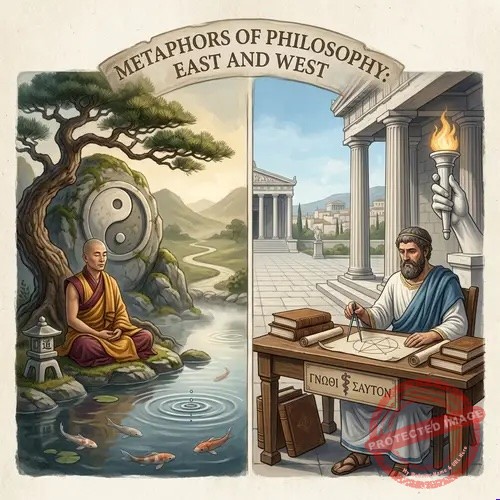
“Certain East Asian traditions, though, take a different route by looking at the bigger picture first. Instead of demanding an immediate explanation for every single element, they allow meaning to emerge gradually from the whole. When encountering the inexplicable, they don’t just stop there. Instead, they just keep focusing on how the interconnected pieces unfold until the entire system comes into view. For them, seeing how everything fits together is exactly how you make sense of the individual parts.
“This was precisely what happened with the professor. Grasping the full, interconnected situation finally freed him from his first impressions, allowing him to truly understand what he had once written off as total ‘nonsense.'”
After explaining, Anh Tâm smiled and playfully teased me in his heavy, imitated Southern accent:
“We ain’t gone off the rails here. We’re just running on two completely different tracks! Make no mistake: at the end of the day, these two tracks lead to the same destination.”
Then, his voice dropped its theatrical drawl, and his expression softened as the humor gave way to deep sincerity. He offered some truly enlightening words:
“You do not want to oversimplify or judge the professor too quickly. By giving full marks and commenting ‘Wise story!’, he wasn’t rejecting its wisdom. Instead, he turned down your outline because you left out the underlying reasoning.”
In hindsight, I had assumed the proverb’s wisdom spoke for itself. I eventually realized that my professor hadn’t dismissed the story itself—he had rejected my outline because I had never explained the reasoning behind it.
Hearing Anh Tâm (Monk Tâm) explain this brought me a profound sense of relief. That nagging feeling that my work had “gone off the rails” instantly vanished, replaced by a much-needed moment of clarity. I couldn’t thank him enough for shifting my perspective.
As evening fell, my Japanese friends returned. Then, we all bowed, thanking Monk Tâm for the visit, before rushing to the station to catch the train back to Tokyo.
To this day, I still remember his words. My outline and my essay had never truly “gone off the rails.” They were simply traveling on different tracks toward the same destination.
Looking back, I realize that wisdom which seems obvious within one cultural framework may require explanation in another. People often operate from different assumptions about how meaning should be conveyed. True understanding begins when we take the time to see why another person’s way of making sense of the world differs from our own.
Trần Trung Tín – June 28, 2026
Invitation:
- We invite you to read the original Vietnamese story: Trật Đường Rầy
Leave a Reply